
HR generalists act as a link between employees and management, and they play a vital role in the smooth operations of an organization.
Besides handling HR functions such as recruiting and benefits administration, HR generalists also promote a positive work environment and resolve conflicts. As HR is essential to the success of any organization, employees in this field benefit from a high level of job security.
The base pay for an HR generalist is $64,124, according to Glassdoor. So, if you’re looking to start your career as an HR generalist with good pay and excellent job prospects, this is the perfect choice for you.
But how can you do that? What is the best career path for an HR generalist? Here we list the career paths for you to understand the career progression of an HR generalist.
To learn more via video, watch below. Otherwise, skip ahead.
What is the HR Generalist Career Path?
Human resources generalists are an integral component of the HR department, responsible for a wide range of personnel-related functions. They oversee recruitment and selection, training and development, employee relations, benefits and compensation, and health and safety. As an HR generalist, you report to the HR manager about your day-to-day HR duties.
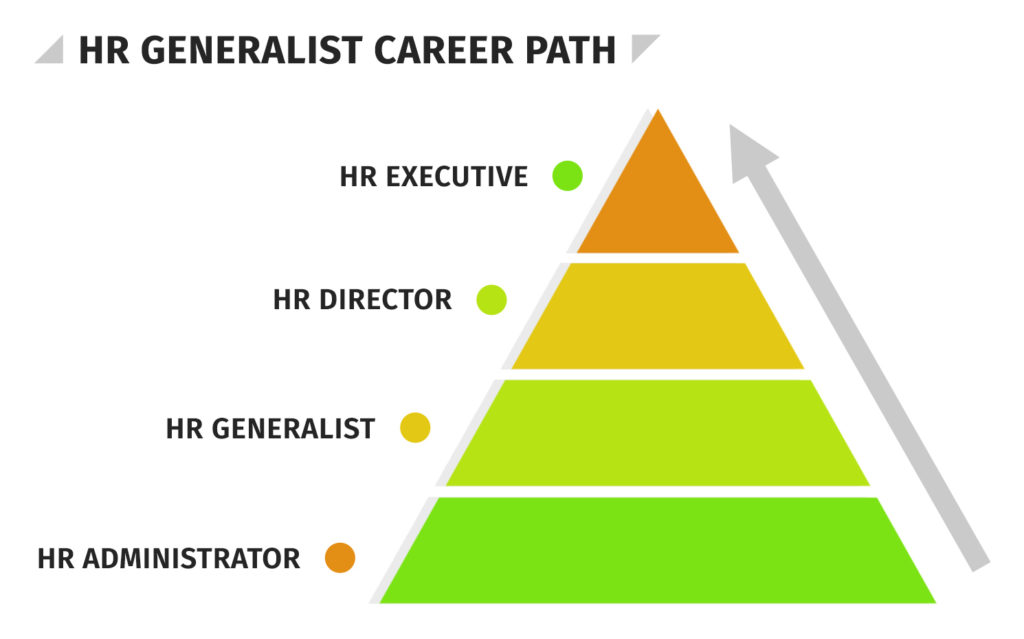
HR generalist is an entry-level position in HR. They are often promoted to HR managers, and then to HR directors‘ posts. We’ll take a detailed overview of an HR generalist career path in the coming sections of this article thus keep reading.
To secure an HR generalist position, you need a minimum of a bachelor’s degree in human resources or a related field. But we recommend joining online courses about human resources to gain more knowledge and experience.
What Does an HR Generalist Career Path Look Like?
Let’s study the career paths of an HR generalist in more detail. The human resources career path of HR generalists starts with HR specialists.
HR Specialist
Human resources specialists are HR professionals, experts in operations of the human resources department, equipped with the right knowledge and skillsets to recruit new talent, facilitate training, and conduct new employee onboarding into the company. HR specialists focus on a certain area of human resources and apply a higher degree of technical skill and specialized knowledge to benefit their organization.
Help the HR officers in improving the hiring process
Implement training and development plans
Prepare and review compensation and benefits packages
Organizing company events
Plan quarter and annual performance review sessions
Inform employees about additional benefits
Update employee records
Maintain organizational charts and detailed job titles, and descriptions along with salary records
Forecast hiring trends
Process employees’ queries and respond on time
Have a strong understanding of labor relations
Preferred Qualifications and Skills
Here are the preferred qualifications and skills for an HR specialist:
Skills: Strong communication skills, solid organizational skills, good people skills
Education: Minimum Bachelor’s Degree or a Master’s degree in HR or a relevant field
Experience: Entry-level experience as an HR assistant
HR Generalist
An HR generalist is someone who handles human resources operations and processes. They often serve as a point of contact for employees and are responsible for managing employee records, benefits, and compliance with policies and procedures.
Job Responsibilities
Here are the job responsibilities of an HR generalist:
Help in recruiting and training new employees
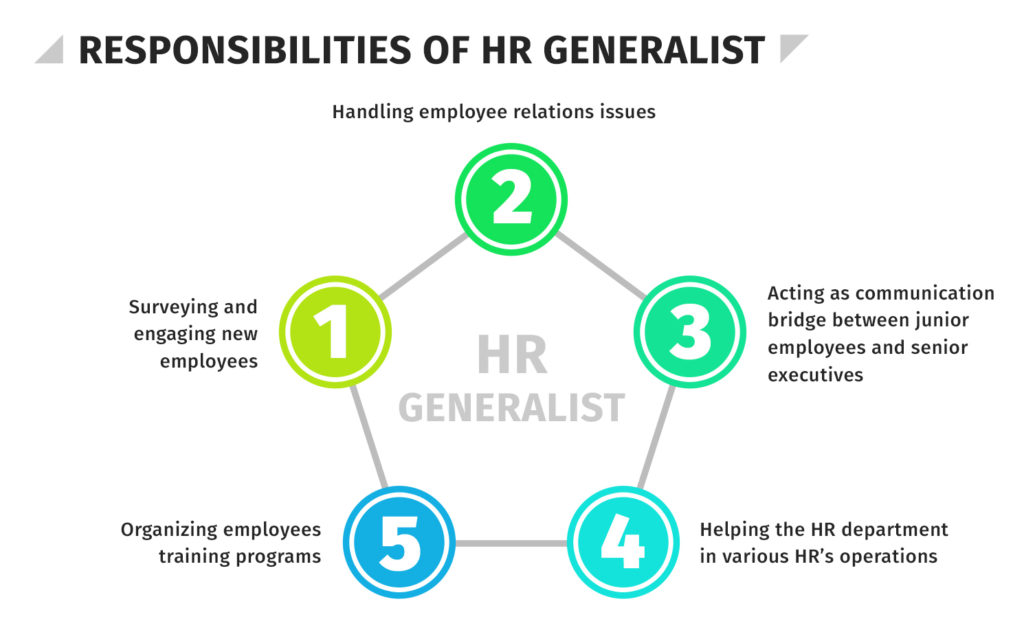
Handling employee relations issues, such as resolving conflict and investigating complaints
Effective communication with employees at all levels of the organization
Help the human resource department with various HR processes
Administer performance management programs
Onboard new employees, conducting orientation sessions, and employee engagement sessions
Develop and implement employee training programs
Improve the HR administration process
Preferred Qualifications and Skills
Here are the qualifications and skills required for an HR generalist:
Strong communication skills: Junior or senior HR generalist needs to communicate with employees at all levels of the organization. They also need to handle difficult conversations, such as performance reviews or disciplinary action.
Solid organizational skills: HR generalists juggle multiple tasks and prioritize their work. They are comfortable working with data and have strong attention to detail.
Good people skills: HR generalists must have the ability to build relationships with employees and create a positive work environment.
Education: At least a bachelor’s degree in human resources or a related field. Some companies also require professional certifications.
Experience: 1 to 4 years
Proficiency: Solid grip on helping senior management, HR teams, and other HR professionals in strategic planning.
The human resources manager is responsible for the effective management of the human resources department. HR managers oversee the employees responsible for recruitment, orientation, and training of new hires. They exhibit excellent problem-solving skills and a strong grip on labor statistics.
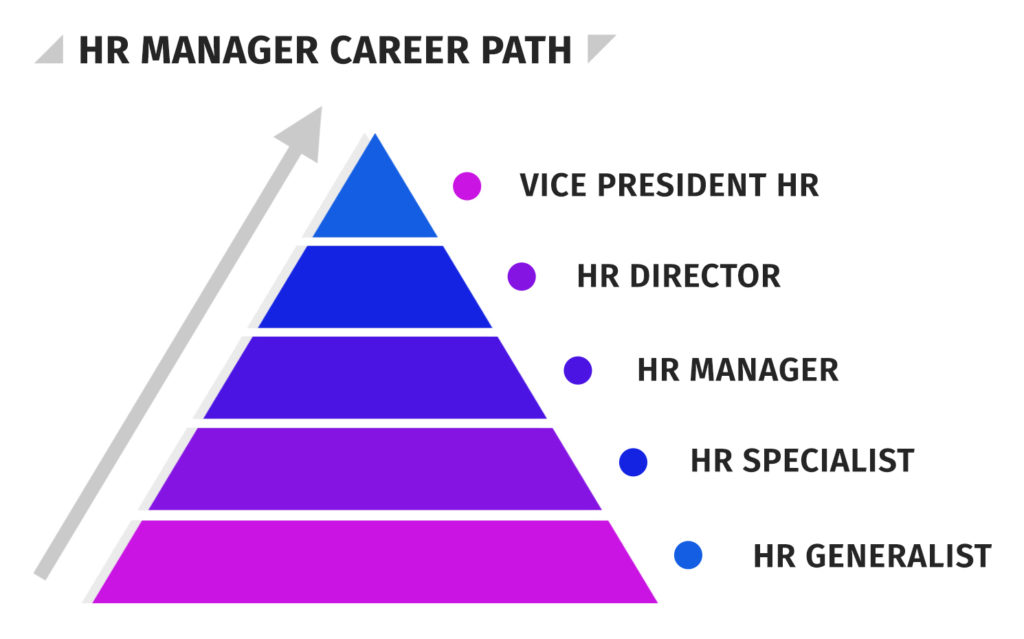
HR managers carry the expertise to manage employee records and benefits and handle employee relations issues.
Job Responsibilities
Here are the job responsibilities of an HR manager:
Partner with the leadership team including the chief HR officer, HR business partner, and human resources director to understand and execute human resource and talent strategy
Align the HR strategy with the HR coordinator, HR executive, and HR administrator to create a strong HR department
Provide support and guidance to HR generalists, management, and other staff
Administer and execute routine tasks such as providing reasonable accommodations, investigating allegations of wrongdoing, and terminations
Manage the talent acquisition process, and hiring of qualified job applicants for managerial, and professional roles
Collaborate with departmental managers to understand requirements for training programs
Analyze trends in compensation and benefits and propose competitive base and incentive pay programs to ensure the organization attracts and retains top talent
Create learning and development programs that provide growth opportunities for employees
Oversee employee disciplinary meetings, terminations, and investigations
Maintain compliance with federal, state, and local employment laws and regulations
Maintain knowledge of trends, best HR practices, regulatory changes, and new technologies
Preferred Qualifications and Skills
Here are the qualification and skills required for an HR manager
Skills: Strong communication skills, organizational skills, people skills
Education: Bachelor’s degree in human resources or a related field with certifications in human resource management
Experience: 3-5 years of experience in HR
HR Director
The human resources director is one of the senior-most positions in the human resource department. After showing solid performance as an HR manager, the company can consider promoting you to the position of HR Director.
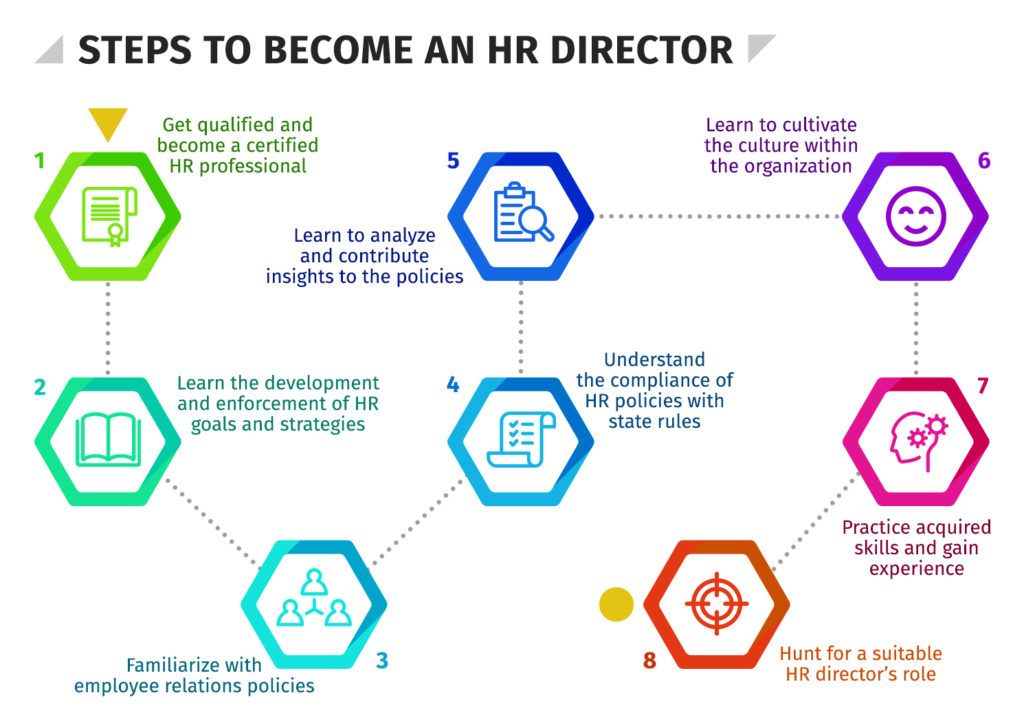
With better perks, a higher salary, and more job responsibilities, this position will cement your authority in the HR department. Let’s have a look at an HR director’s job duties, skills, and qualifications:
Job Responsibilities
Here are the duties of an HR director:
Development and implementation of policies and procedures
Administration of benefits
Coordination of training and development programs
Strategic management of payroll and taxes
Provision of guidance and support to employees
Serve as the liaison between the company and external organizations such as government agencies, unions, and professional associations
Manage organizational budgets
Introduce training programs for the HR staff and other employees
Report to the CEO or President of the company
Preferred Qualifications and Skills
Here are the preferred qualifications and skills needed for an HR director:
Skills: Excellent verbal and written communication skills, interpersonal skills, negotiation skills, organizational skills, and time management skills with a proven ability to meet deadlines, supervisory and leadership skills
Proficiency: Ability to prioritize tasks and delegate whenever appropriate. Thorough knowledge of employment-related laws and regulations. Proficient with Microsoft Office Suite or related HRIS software
Experience: 5-10 years of experience
Education: Minimum of bachelor’s or master’s degree with certifications in HR and relevant field
Vice President HR
The vice president of human resources is responsible for the overall senior management of the HR department. After gaining experience and showing positive results as an HR Director, the VP of HR is the position to go for your career progression.
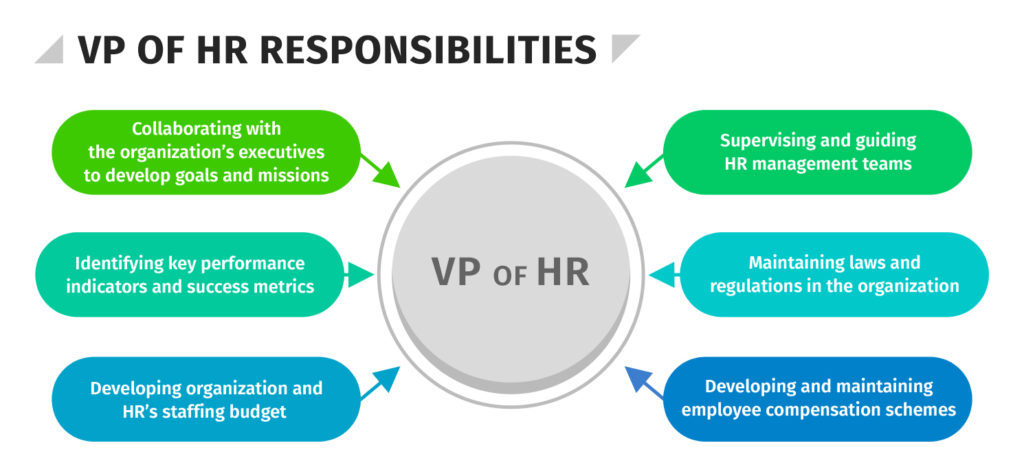
The VP of HR sets strategic goals, develops and implements policies and programs, and manages the budget. The VP also works with HR managers and senior HR professionals to ensure that the HR department is on the same page with the company’s business objectives. Moreover, the VP is also responsible for building and maintaining relationships with employees, union representatives, and other stakeholders.
A VP of HR is the same as a chief human resources officer, hence is responsible for the effective management of the entire organization’s goals and vision.
Job Responsibilities
Here are the job responsibilities of a VP of HR:
Collaborate with executive leadership to define long-term mission and goals
Identify loopholes in the HR strategy and close them through talent management
Identify key performance indicators for human resource and talent management functions
Assess organizational success and market competitiveness
Research, develop, and implement competitive compensation, benefits, performance appraisal, and employee incentive programs
Conduct unbiased investigations and escalate them to the legal and security team
Ensure compliance with employment, benefits, insurance, safety, and other laws, regulations, and requirements
Draft and implement the budget for the human resource department and the company
Partner with the management to address day-to-day HR operational issues
Supervise and lead the HR team in creating a cohesive employee experience
Act as an employee champion and change agent
Providing insightful crisis management advice
Maintain knowledge of industry trends and employment legislation to ensure regulatory compliance
Preferred Qualifications and Skills
Here are the preferred qualifications and skills required for a VP of HR:
Experience: 7-10 years of experience in a senior position in the HR department
Proficiency: Expert in strategic planning and implementation, deep knowledge of HR functions, ability to use metrics and analytics, knowledge of local and international labor law, and hands-on experience in using MS Office and HRIS programs
Skills: Excellent communication, interpersonal, leadership, problem-solving, and organizational skills
Education: Minimum master’s degree in HR or relevant field with certifications in HR
Conclusion
An HR generalist’s career path is rewarding if you follow it with the right devotion. In fact, it is a great choice to start your career in HR to excel. All that you have to focus on is to keep upskilling and improving your knowledge to reach the highest step in the HR career path.
Stay up to date with the latest HR trends.
Get the weekly newsletter keeping 30,000+ HR pros in the loop.