Our reviewers evaluate software independently. Learn how we stay transparent, our methodology, and tell us about anything we missed.

Our reviewers evaluate software independently. Learn how we stay transparent, our methodology, and tell us about anything we missed.
I’ve had to build onboarding systems for remote and hybrid teams across growing companies, and it’s one of those functions people underestimate until it starts breaking. When new hires don’t have the right paperwork, the right systems access, or a clear understanding of what success looks like, the whole company feels it pretty quickly.
That’s why I like this role so much. A strong onboarding specialist makes a company feel organized, welcoming, and credible from day one. A weak onboarding process does the opposite, even when the company itself is great.
A lot of articles on this topic stay way too generic. They make the role sound like a basic admin job, when in reality it sits at the intersection of HR operations, candidate experience, compliance, training, and internal communication. In this guide, I’m breaking down what onboarding specialists actually do, what skills matter most, how the career path develops, and what kind of compensation you can realistically expect. Let’s get into it.
An onboarding specialist is the person who helps new hires move from signed offer to productive employee without that awkward, messy gap in the middle. They usually sit inside HR or people operations, and they coordinate the logistics, communication, systems setup, and early employee experience that shape a new hire’s first few days and weeks.
The easiest way I think about this role is through three goals: readiness, clarity, and connection. Readiness means paperwork, HRIS records, payroll coordination, and IT setup are handled before problems show up. Clarity means new hires know the company policies, their first-week plan, their training schedule, and what’s expected of them. Connection means they actually feel welcomed into the team instead of dumped into a Slack channel and left to figure it out alone.
That’s also why this role matters more than people assume. Good onboarding improves time to productivity, reduces early turnover, and gives managers a stronger starting point with new employees. If you want the broader context behind the role, this guide to employee onboarding is a useful companion because it explains the full process that onboarding specialists help run behind the scenes.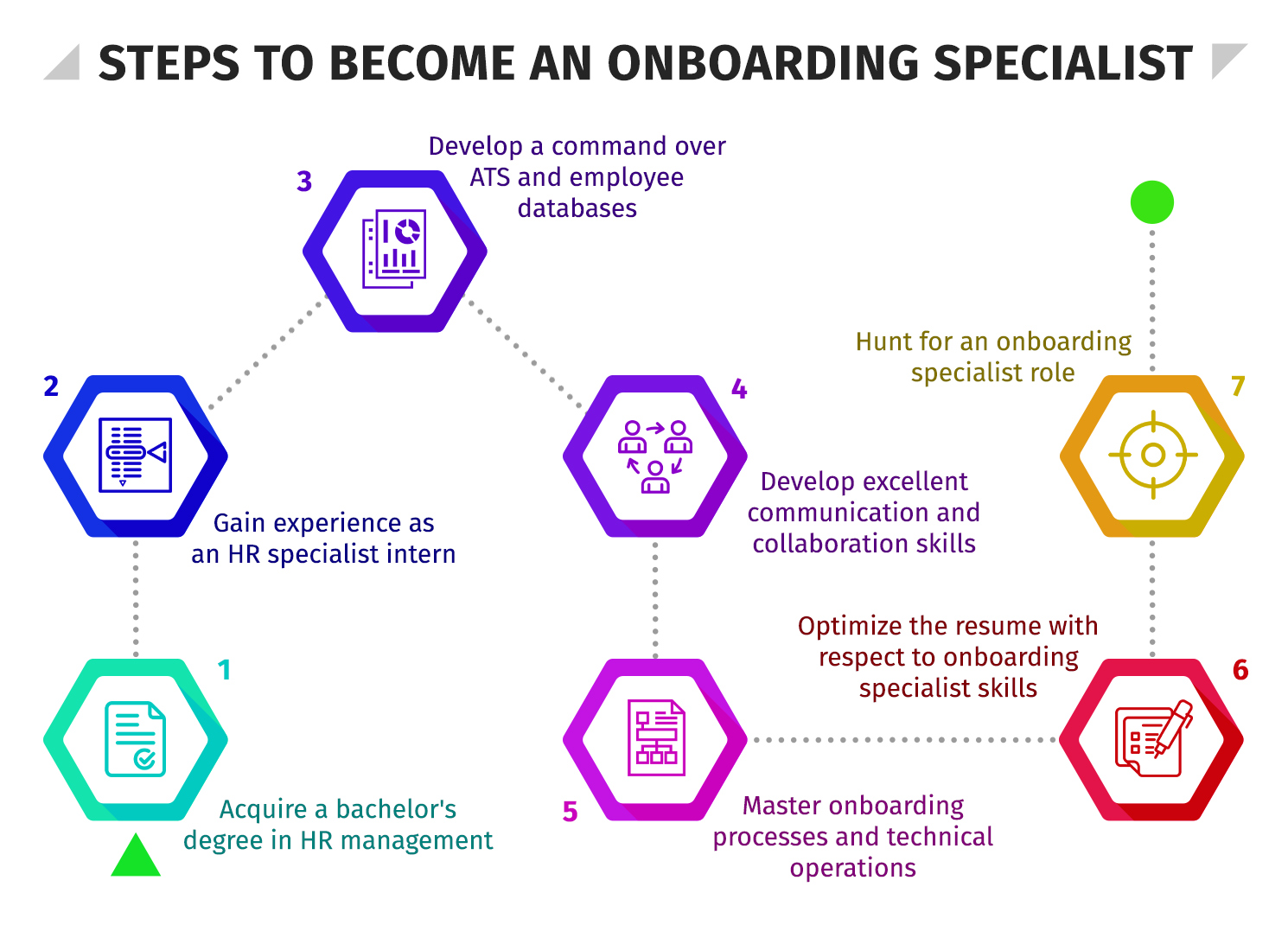
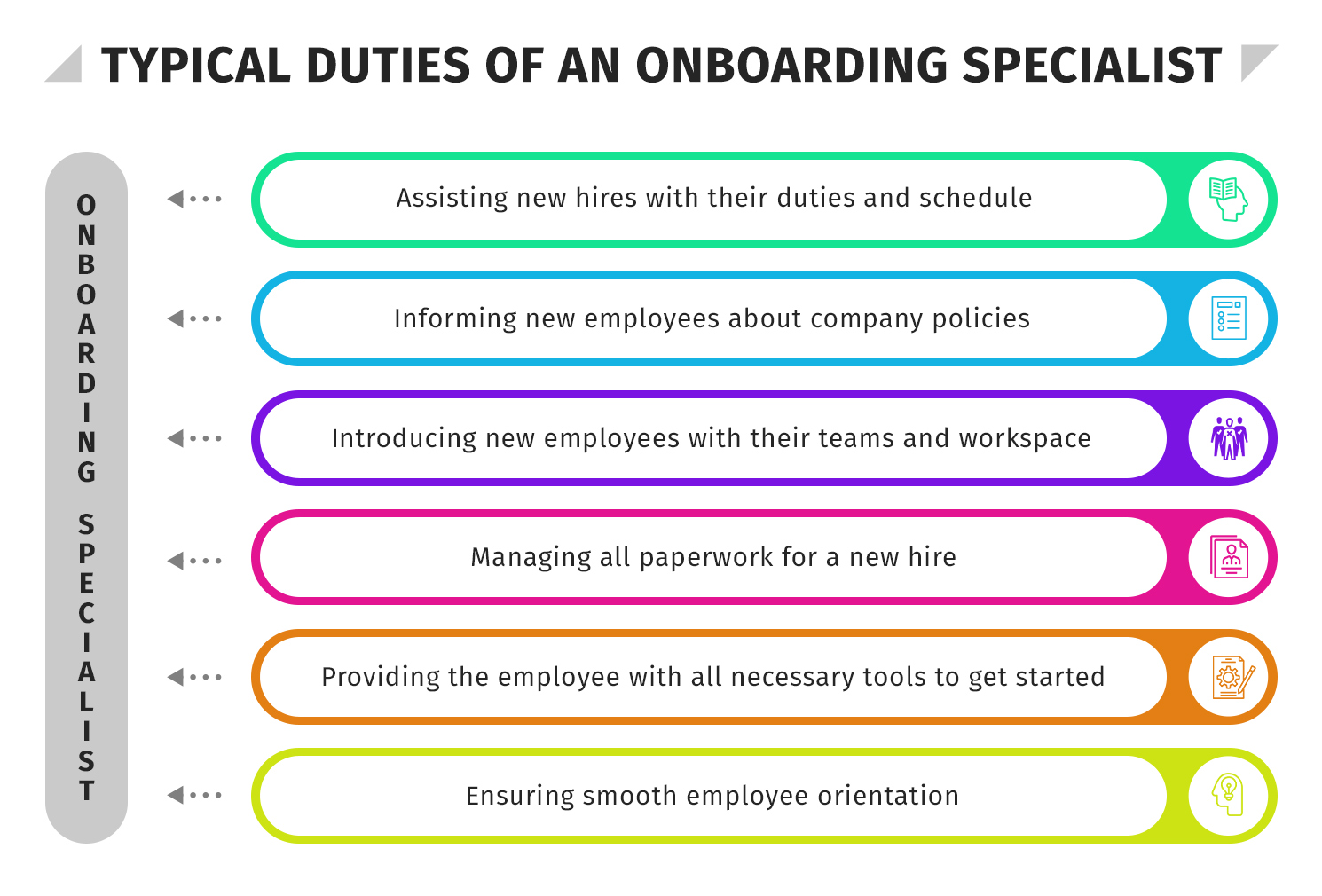
Most onboarding specialists spend their days coordinating a surprising number of moving parts. The job usually starts before the employee’s first day, because that’s when the details need to come together. Offer acceptance triggers background admin work, but it also kicks off the welcome experience the new hire is about to judge the company on.
One big part of the role is managing onboarding documents. That includes offer follow-up materials, tax forms, payroll details, direct deposit setup, benefits enrollment information, form I-9 verification where applicable, and policy acknowledgments. In a lot of companies, this work overlaps with templates and workflows like these new hire paperwork templates, especially when the onboarding team is trying to make the process more consistent.
Another major responsibility is communication. Onboarding specialists often send preboarding emails, answer first-day questions, coordinate team introductions, and make sure the new hire knows what to expect. They may also prepare employee welcome kits, distribute the employee handbook, walk through company policies, and organize onboarding presentations that explain the company’s mission, structure, and internal tools.
Then there’s the systems side, which is where the role becomes much more operational than people expect. An onboarding specialist may coordinate with IT on laptop delivery, email setup, permissions, software logins, and access to collaboration tools. They also usually work in an HRIS, update employee records, confirm payroll handoffs, and track whether each step in the onboarding process is complete. If the company is formalizing the function, the role often overlaps with what you’d see in HR onboarding specialist job description examples, especially when onboarding becomes a dedicated HR specialty.
A good onboarding specialist also helps translate the process into experience. They don’t just schedule training. They make sure the training plan makes sense, that managers have prepared performance goals for the first 30 to 90 days, and that the new hire has enough context to feel capable instead of overwhelmed.
The skills that matter most in this role are not flashy, but they are incredibly valuable.
Communication is probably the biggest one. Onboarding specialists spend a lot of time explaining steps, answering repetitive questions without sounding impatient, and making people feel supported when everything is still new to them.
Organization is a close second. This job can involve multiple start dates, different managers, several systems, and a long list of documents or checkpoints that have to happen in the right order. Someone can be warm and personable, but if they miss payroll information or forget an I-9 step, the experience breaks down fast.
I also think training and teaching skills matter more than most job descriptions admit. A strong onboarding specialist is often part coordinator, part guide, and part translator. They help new hires understand policies, internal processes, and day-one expectations in a way that sticks. That is especially important when onboarding includes structured orientation sessions, tool demos, or presentations for larger hiring classes.
On the technical side, most employers want comfort with applicant tracking systems, HRIS platforms, presentation software, and virtual communication tools. In more mature HR teams, the role may also involve onboarding software, digital document workflows, and dashboards that track completion rates or new-hire progress. If you’re trying to get sharper on the systems side of the job, it helps to review the best HRIS systems and best employee onboarding software because those tools shape a lot of the actual day-to-day workflow.
Problem-solving is another underrated competency here. Things go wrong all the time. A laptop arrives late. A manager forgets a training plan. Payroll details are incomplete. A new employee starts remotely from another state or country and suddenly there are extra compliance steps. The best onboarding specialists stay calm, solve the issue, and keep the new hire from feeling the chaos behind the curtain.
Wanting to make your career successful as an onboarding specialist? View our top HR certifications and get one now.
Most onboarding specialist roles ask for a bachelor’s degree, but the major itself can vary more than people think. Human resources management is the most obvious fit, but I’ve also seen strong candidates come from business administration, communications, psychology, and related people-facing fields.
What matters just as much as the degree is whether someone has learned how HR processes actually work. Entry-level HR positions, internships, recruiting coordinator roles, or admin support work inside a people team can all build the right foundation. That hands-on exposure teaches you how documents move, how employee questions get handled, and how compliance and communication interact in the real world.
Certifications can help, especially if you want to stand out or move up faster. The SHRM-CP certification is one of the more recognizable options for people doing general HR work or building toward broader HR responsibility. If your role leans more into recruiting and talent acquisition lifecycle work, a recruiting-focused program can also be helpful, but I’d usually treat that as a supplement rather than a substitute for experience.
I’d also keep learning in smaller, practical ways. Staying current on employment law updates, payroll changes, onboarding systems, virtual training methods, and internal documentation practices can make a real difference. Onboarding looks simple from the outside, but the people who get good at it usually understand much more than just welcome emails and orientation schedules.
Onboarding specialists show up in more industries than most people realize. You’ll see them in software companies, staffing firms, healthcare organizations, consulting businesses, professional services teams, enterprise employers, and government environments. The title stays similar, but the actual work can feel very different depending on the setting.
In high-growth tech or computer systems design environments, the role often leans heavily on tools, speed, and cross-functional coordination. There may be more emphasis on IT setup, remote onboarding, software access, and helping new hires ramp into fast-moving teams.
In employment services or high-volume hiring environments, the role can become more process-driven, with tighter turnaround times and more repeated onboarding cycles.
In larger enterprises or government-related settings, the work usually gets more structured. Documentation standards may be stricter, compliance expectations may be higher, and coordination with payroll, benefits, security, and multiple departments can become more formal. In those environments, the onboarding specialist often becomes a central operator who keeps everyone aligned.
The work environment itself also varies. Some onboarding specialists are fully on-site because they manage office tours, equipment, and in-person orientation. Others work in hybrid or remote-first companies, where the job depends more on written communication, virtual communication software, and carefully documented workflows. I’ve seen excellent onboarding people succeed in both models, but remote environments usually demand more process discipline because you can’t rely on hallway conversations to patch a broken system.
Onboarding specialist compensation usually sits inside the broader HR specialist range, but the actual pay can move quite a bit depending on industry, location, and scope. A role that mainly handles paperwork and orientation scheduling will usually pay less than one that also owns HRIS workflows, payroll coordination, compliance tasks, and reporting.
Experience level matters a lot too. Entry-level onboarding specialists or coordinators typically start at the lower end of the range, while professionals who manage complex onboarding across multiple teams or locations can push into stronger mid-level compensation. Companies that hire at high volume, operate across different states, or rely on tight process execution often value this role more than their title bands initially suggest.
The benefits package matters more than people think here. Paid time off, health insurance, notice of pay and benefits, overtime pay policy, remote flexibility, and fringe benefits can change the quality of an offer quite a bit. I’d never evaluate this role on base salary alone, especially if the job includes a lot of coordination work that can spill outside normal hours.
If you want a role-specific estimate, this onboarding specialist salary guide is the most direct internal reference point. For broader labor market context, the U.S. Bureau of Labor Statistics page for human resources specialists is a useful benchmark because many onboarding roles sit close to that occupational family.
One reason I like this role is that it can lead in several different directions. For some people, it becomes a long-term HR operations path. For others, it becomes a stepping stone into broader generalist, talent acquisition, or business partner work.
A common starting point is an internship, HR assistant role, recruiting coordinator job, or people operations support position. From there, someone might move into an HR onboarding specialist or onboarding coordinator role where they take more ownership over systems, process design, and new-hire experience. If you’re still at the very beginning, reading about what a human resources intern does can help you see how the early career steps connect.
From mid-level to senior roles, the path often depends on what strengths you build. Someone who gets strong at workflows, documentation, payroll systems, and cross-functional execution may move toward HR operations specialist roles. Someone who gets stronger in employee relations, manager support, and broader people processes may grow into generalist or HRBP work, which is why I often recommend looking at the wider human resources career path and roles like HR business partner.
There’s also a more specialized version of the path. Some professionals become senior HR onboarding specialists and start owning program design, onboarding metrics, mentorships, manager enablement, and larger onboarding team initiatives. Others use the role as a launchpad into talent acquisition, since onboarding sits so close to the end of the recruiting funnel and the broader talent acquisition lifecycle.
If I were trying to advance from this role, I’d focus on three things. First, get excellent at systems and process reliability. Second, learn how to work with managers, not just new hires. Third, understand how onboarding affects retention, employee engagement, and speed to productivity. That combination makes you much more promotable than simply being “the person who runs orientation.”
On the practical side, interview preparation also helps if you’re trying to level up. These onboarding specialist interview questions are useful because they show the kinds of process, communication, and judgment questions employers tend to ask for the role.
The onboarding specialist role is one of those jobs that looks straightforward until you see how much trust and coordination it requires. Done well, it helps new hires feel supported, helps managers start strong with their teams, and helps the company avoid a lot of preventable friction.
That’s also why I think it’s a smart role for someone who wants a real HR foundation. You learn systems, communication, training, compliance, and cross-functional execution all at once. If you can get good at onboarding, you build a skill set that transfers surprisingly well across the rest of HR.
The onboarding specialist role plays a vital part in shaping positive new-hire experiences and improving retention. While it can appear administrative, the job blends organizational skills, communication, technical knowledge, and problem-solving to create real impact.
For those pursuing this career, onboarding offers a strong HR foundation, with opportunities to grow into HR operations, talent acquisition, or other advanced roles. By focusing on improving processes and collaboration with managers, onboarding specialists can expand their impact and unlock career growth.
Onboarding is more than just paperwork. It’s about creating structured, engaging experiences that help both employees and companies succeed.
Here I answer the most frequently asked questions about the onboarding specialist role.
Usually, they work in HR, people operations, or a closely related function. In smaller companies, the role may sit inside a general HR team, while in larger companies it can be part of a dedicated onboarding team or people operations group.
It can be, but not always. Some companies hire entry-level candidates with strong admin, communication, or recruiting support experience, while others want someone who already understands HR systems, payroll coordination, and onboarding compliance.
Most use an HRIS, document management tools, communication platforms, calendar systems, presentation software, and sometimes dedicated onboarding software. In more mature teams, they may also work with applicant tracking systems, reporting dashboards, and payroll platforms.
Not necessarily. A degree in human resources helps, but I’ve also seen people enter the field from business administration, communications, psychology, and adjacent support roles. Experience and process knowledge often matter just as much.
An onboarding specialist focuses more narrowly on the new-hire process, paperwork, systems access, orientation, and early employee experience. An HR generalist usually owns a broader mix of responsibilities, such as employee relations, benefits, compliance, recruiting support, and performance processes.
Yes, but it usually takes broader HR exposure first. The strongest path is to build onboarding expertise, then expand into employee relations, manager support, compliance, and people strategy so you can move from process ownership into business partnership.
Get the weekly newsletter keeping 30,000+ HR pros in the loop.
Learn modern HR management and advance your career.
















Get our #1 industry rated weekly technical writing reads newsletter.
Your syllabus has been sent to your email